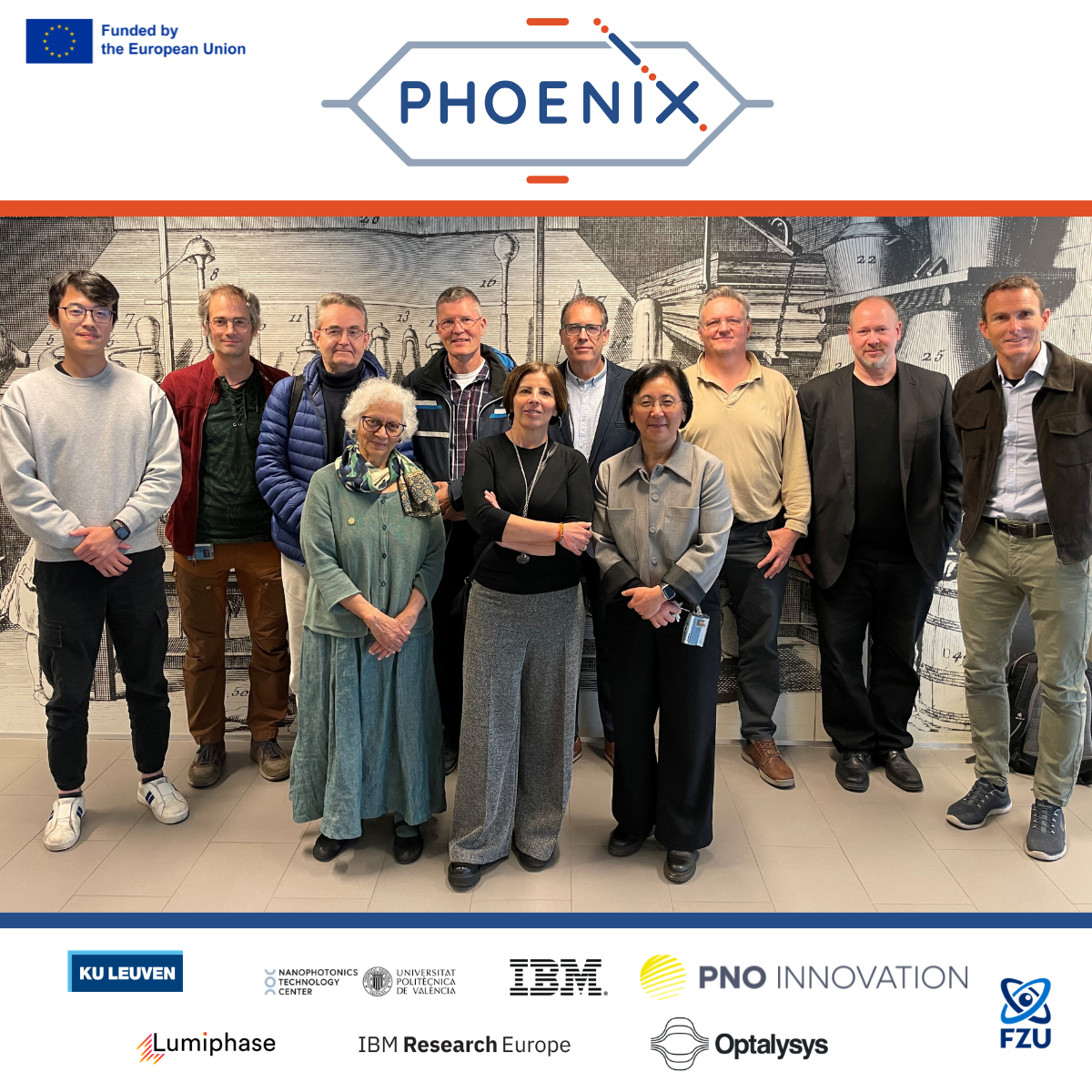
After 42 months of collaboration, research, innovation and technological development, the PHOENIX project successfully held its Final Review Meeting on 19 May 2026 in Leuven, Belgium, hosted by KU Leuven. The meeting brought together project partners, researchers and reviewers to present the final achievements of the project and discuss the impact of PHOENIX on the future of photonic integrated circuits (PICs).
Funded under Horizon Europe, PHOENIX — Ferroelectric PHOtonics ENablIng novel functionalities and enhanced performance of neXt generation PICs , aimed to develop next-generation photonic technologies by combining barium titanate (BTO) and vanadium oxide (VOx) materials to enable programmable, energy-efficient and scalable photonic integrated circuits.
During the final meeting, partners showcased the progress achieved across the project’s technical work packages, from material design and PIC fabrication to system integration and application demonstrators.
One of the highlights of the meeting was the presentation of the advances in the 300 mm molecular beam epitaxy (MBE) system and thin-film characterization infrastructure at KU Leuven. The consortium demonstrated successful progress toward large-scale integration of VO₂ on silicon and BTO platforms, paving the way for scalable photonic manufacturing.
The consortium also presented the successful fabrication and testing of hybrid BTO/VO₂ photonic devices. Results included low-loss BTO modulators, VO₂-enabled optical switching functionalities, and integrated photonic platforms for neuromorphic computing and secure data processing.
PHOENIX further demonstrated the potential of photonic acceleration for Fully Homomorphic Encryption (FHE) applications through the development of the System OnE and EntrOPy platforms. These demonstrators validated the execution of key FHE operations on photonic hardware and confirmed the feasibility of secure and energy-efficient optical computing architectures.
In parallel, the project showcased advances in photonic neural network demonstrators, including the DNN1 chip integrating BTO phase shifters and tunable couplers for convolution operations and AI inference applications.
Beyond the technical achievements, the meeting also reviewed the strong dissemination and communication activities carried out throughout the project. PHOENIX established a solid presence within the European photonics ecosystem through conferences, scientific publications, clustering activities and collaboration with its sister project ADOPTION. The project achieved more than 14,000 website visits, 323 LinkedIn followers, 87 social media posts, participation in 30 scientific events and 19 scientific publications.
The final review meeting concluded with a visit to KU Leuven’s research facilities, where attendees had the opportunity to explore the advanced experimental infrastructure used during the project and discuss future perspectives for photonic technologies in AI, telecommunications, neuromorphic computing and secure computing applications.
As PHOENIX comes to an end, the project leaves behind a strong technological foundation and a collaborative European ecosystem that will continue driving innovation in integrated photonics and emerging optical computing technologies.
This project has received funding from the European Union’s Horizon Europe programme under Grant Agreement No. 101070690.